
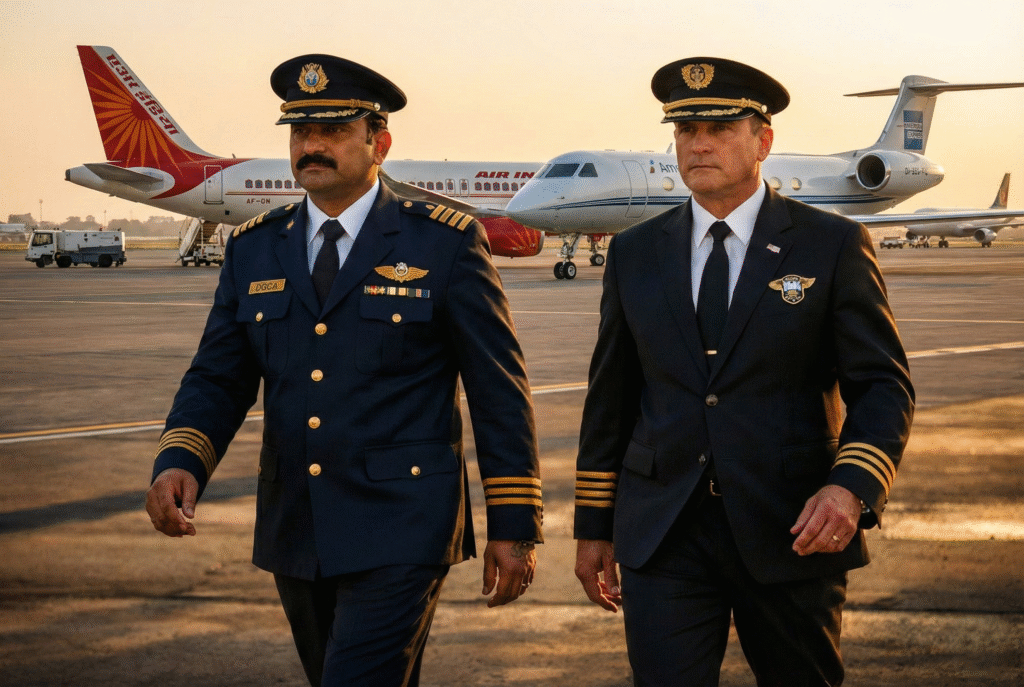
Deciding between a DGCA (Directorate General of Civil Aviation) license and an FAA (Federal Aviation Administration) license is one of the first and most critical crossroads an aspiring Indian pilot will face. It is a decision that dictates not just where you train, but where you can fly, how fast your career progresses, and the global opportunities available to you.
For students in India, the traditional route has been to stay domestic. However, as the aviation industry becomes increasingly globalized, the limitations of a purely domestic license are becoming apparent. Conversely, the FAA license, issued by the United States, is widely regarded as the gold standard in aviation. But is it the right choice for you?
To make an informed decision, we must analyze the DGCA vs FAA license debate through the lenses of global recognition, training quality, and long-term career mobility.
The Global Recognition of an FAA License
The DGCA license is the regulatory requirement for flying Indian-registered aircraft. It is essential if your sole goal is to fly domestically within India immediately upon graduation.
On the other hand, the FAA license is the “passport” of the aviation world. Recognized by International Civil Aviation Organization (ICAO) member states globally, an FAA license offers unparalleled career mobility.
- Global Reach: An FAA license holder can easily validate their license to fly in numerous countries outside the US, whereas a DGCA license is strictly tied to Indian regulations.
- Aircraft Versatility: Most of the world’s commercial aircraft (Boeing, Gulfstream, Cessna) are manufactured in the US and certified by the FAA. Training on these standards gives you an innate understanding of the machinery you will command.
- Career Flexibility: With an FAA license, you are not limited to one market. You can pursue careers in the US (via the OPT pathway), the Middle East, or Asia, giving you a safety net against regional market downturns.
For students aiming for a high-flying international career, the FAA license acts as a universal key, unlocking doors that a domestic license cannot.
Training Standards: Why the US Ecosystem Wins
When comparing DGCA vs FAA license pathways, the training environment is a massive differentiator. The United States has the most robust general aviation infrastructure in the world, and World Wide Wings leverages this to produce superior pilots.
1. FAA Part 141 Certification
Our programs are conducted under FAA Part 141 regulations. This is a rigorous, structured syllabus monitored directly by the FAA, ensuring consistent quality. In contrast, many flight schools in India struggle with infrastructure delays, airspace restrictions, and inconsistent training timelines.
2. Weather and Infrastructure
Training in India is often plagued by monsoon delays and limited airspace. At our campuses in San Bernardino, California, students enjoy over 300 days of flyable weather annually. This continuity allows you to build muscle memory and complete your training in 10-12 months, compared to the 18-24 months often required in India.
3. English Proficiency
Aviation English is the language of the skies. Training in the US immerses you in an English-speaking ATC (Air Traffic Control) environment, honing your communication skills to a native professional level, a critical soft skill for airline interviews.
The Smart Strategy: DGCA License Conversion
A common misconception is that you must choose one license exclusively. The smartest career move, championed by the Global Aviators Program, is to pursue Dual Certification.
Our programs are FAA-certified and DGCA Approved. This means you train to the high standards of the US FAA, but your logbooks and syllabus are structured to meet Indian DGCA requirements perfectly.
The Conversion Advantage
To fly in India with an FAA license, you must convert it to a DGCA license. We have streamlined this process to ensure zero friction:
- Flying Requirements: Our curriculum includes the specific cross-country and instrument hours mandated by the DGCA, so you don’t need “remedial” flying upon return.
- Simultaneous Progress: While your peers in India are waiting for aircraft availability, you are flying daily in the US, securing your FAA CPL, and banking the flight hours needed for conversion.
Career Opportunities: The “Learn & Earn” Difference
The DGCA vs FAA license debate ultimately comes down to ROI (Return on Investment) and career trajectory.
The Traditional DGCA Path
- Cost: High
- Outcome: A CPL with 200 hours.
- Reality: You graduate into a saturated market with minimum flight experience. You often have to pay extra for a Type Rating just to be eligible for airline interviews.
The World Wide Wings FAA Path
- Cost: Lower net cost (thanks to scholarships and earning potential).
- Outcome: FAA CPL + B.S. in Aeronautics + CFI Ratings.
- Reality: You enter the “Learn & Earn” phase. Instead of paying to fly, you work as a Certified Flight Instructor in the US during your 3-year Optional Practical Training (OPT).
Conclusion: The Competitive Edge
In the battle of DGCA vs FAA license, the winner is clear for the ambitious student. While the DGCA license is necessary for Indian employment, obtaining it via the FAA route offers a significant competitive advantage.
You get the global prestige of US training, the academic weight of a B.S. in Aeronautics, and the financial freedom of the “Learn & Earn” program. By choosing World Wide Wings, you aren’t just getting a license; you are securing an Assured Career Pathway that bridges the gap between Indian requirements and global standards.
Don’t limit your horizon. Train globally to fly locally, or anywhere else you choose.